What Australian and APAC Businesses Need to Know
As we step into 2026, artificial intelligence has moved well beyond the hype cycle. We’re now firmly in what I call ‘Wave 3’ of AI adoption – the practical application phase where real business value is being created, and smart organisations are gaining genuine competitive advantage.
For Australian businesses and those across the broader Asia-Pacific region, this year represents a pivotal moment. The groundwork has been laid. The technology has matured. And the organisations that act decisively now will shape the next decade of their industries.
Here’s what you need to know about where AI is heading in 2026 and how to position your organisation to thrive.
Australia Steps Up: The National AI Plan
The Australian Government has released its National AI Plan, setting a clear pathway for the country to become a leader in trusted, world-class AI solutions. This isn’t just policy talk—it’s backed by significant investment and concrete action.
Key highlights include:
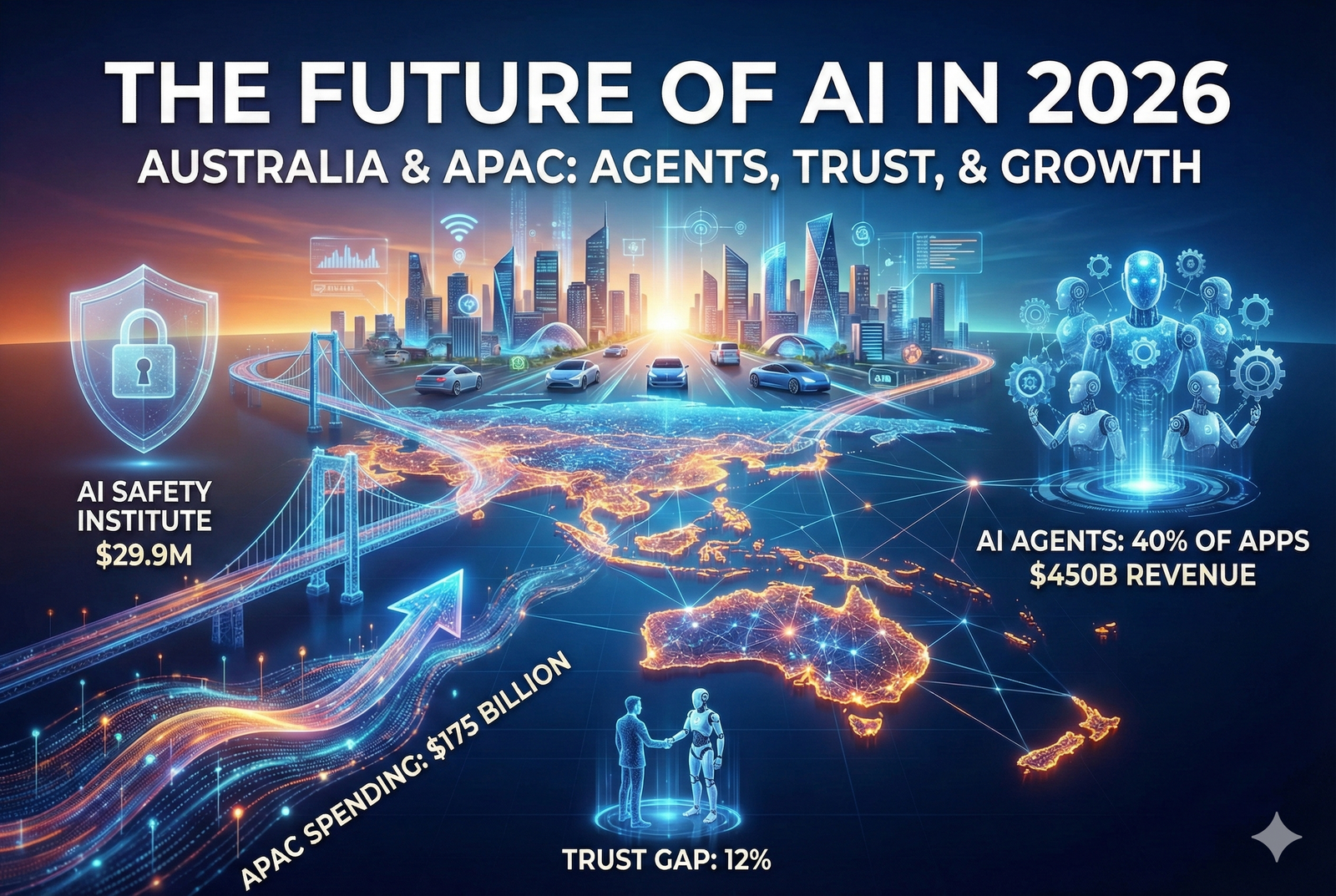
- $29.9 million to establish an AI Safety Institute in early 2026, ensuring government oversight of emerging AI capabilities and risks
- $17 million AI Adopt Programme providing targeted support for SMEs implementing AI, regardless of their sector or size
- Major workforce development initiatives through TAFE, vocational training, and the Future Skills Organisation to build AI literacy across all levels
- GovAI framework addressing security needs for businesses deploying AI and robotics, providing clarity for companies investing in advanced technologies
Perhaps most significantly, every public servant will gain access to generative AI tools and receive foundational training by mid-2026. This signals a fundamental shift in how government—and by extension, Australian business—views AI: not as a threat to be managed, but as a capability to be embraced responsibly.
APAC: Leading the Global AI Charge
The Asia-Pacific region isn’t just keeping pace with global AI development—we’re leading it. According to Confluent’s 2025 Data Streaming report, 56% of APAC businesses have already deployed chatbots, copilots, and AI assistants, outpacing both Europe and North America.
"APAC AI spending is forecast to reach $175 billion by 2028. Countries that embrace AI infrastructure and invest in it as a strategic national asset will build lasting advantage."
What’s driving this regional leadership? Several factors:
- Fewer legacy systems: Many APAC businesses can leapfrog older technology stacks
- Faster policy cycles: Government frameworks like Singapore’s National AI Strategy 2.0 and Australia’s National AI Plan are moving quickly
- Strong bias for execution: The region has a culture of implementing rather than endlessly debating
- Leaner IT teams: With 68% of organisations operating with fewer than 25 IT employees, AI becomes an essential force multiplier
Singapore is piloting AI-powered scam detection systems. Bangkok is testing AI-optimised traffic systems. Indonesia is deploying AI platforms to tackle climate-driven diseases. This is AI being deployed for real-world impact, not just productivity gains.
2026: The Year of AI Agents
If there’s one AI development that will define 2026, it’s the mainstream emergence of AI agents—software systems that can autonomously plan, execute, and complete complex tasks without constant human oversight.
The numbers are compelling:
- Gartner predicts 40% of enterprise applications will include task-specific AI agents by the end of 2026—up from less than 5% in 2025
- By 2026, up to 40% of all Global 2000 job roles will involve working alongside AI agents
- 81% of organisations currently using AI agents plan to expand into more complex use cases in 2026
- In a best-case scenario, agentic AI could generate $450 billion in enterprise software revenue by 2035
What does this mean in practice? Rather than AI simply assisting humans in the background, it’s increasingly acting as a digital colleague—one that can reason, coordinate, and make decisions. Customer service agents that resolve queries end-to-end. Finance agents that process invoices and flag anomalies. Operations agents that monitor systems and initiate responses automatically.
For Australian SMEs, this represents a massive opportunity. Done-for-you AI agents can now handle website enquiries, WhatsApp customer service, appointment booking, and lead qualification—tasks that previously required dedicated staff. Organisations can deploy these solutions in 4-6 weeks, not months.
The Human Element: Where AI Still Needs Us
Despite all the automation advances, 2026 makes one thing abundantly clear: AI transformation is fundamentally about people.
Here’s the uncomfortable truth many organisations are discovering: only 12% of businesses currently trust AI to act autonomously. This ‘trust gap’ is the single biggest bottleneck to AI ROI.
The solution isn’t more technology—it’s better change management. According to research, technology delivers only about 20% of an initiative’s value. The other 80% comes from redesigning work—ensuring agents can handle routine tasks while people focus on what truly drives impact.
This is why workforce upskilling has become such a priority. OpenAI’s new partnership with Coles, Commonwealth Bank, and Wesfarmers will deliver AI skills training to more than 1.2 million Australian workers and small businesses—one of the largest coordinated AI skills initiatives in Australia’s history.
“The key to success lies in recognising that agentic transformation is not about replacing humans with machines, but about creating new forms of human-AI collaboration that leverage the unique strengths of both.” — Deloitte
Data Sovereignty: The New Competitive Advantage
In 2026, data sovereignty is evolving from a compliance checkbox into a boardroom priority.
Forrester expects that by 2026, about half of APAC enterprises will make sovereignty-based controls—such as in-region infrastructure and data residency—a top criterion for cloud and AI platforms.
This isn’t just about regulatory compliance. With rising geopolitical volatility and tightening data localisation laws, organisations need clear visibility into where their data resides, who controls it, and how easily it can move when markets shift.
Forward-looking businesses are now mapping their digital supply chains, ensuring applications and assets can move across jurisdictions with minimal friction. When sovereignty is built into design, compliance becomes a competitive advantage.
Cybersecurity: AI as Both Shield and Sword
AI is transforming the cybersecurity landscape in both directions—making attacks more sophisticated while simultaneously enabling better defences.
New threats like ‘vibe hacking’—where AI-crafted messages mimic the tone and trust of executives—are emerging. A compromised AI agent can unleash ten times the damage in one-tenth of the time. Research shows that 98% of Australian security leaders now cite identity-driven attacks as their top concern.
On the defensive side, 79% of APAC senior security leaders plan to boost threat intelligence spending in 2026—higher than their counterparts in Europe and North America. AI is enabling faster threat detection, automated triage, and real-time response capabilities that would have been impossible just a few years ago.
The takeaway? Security can no longer be an afterthought. It must be baked into AI strategy from day one.
The SME Reality Check
Let’s be honest about where Australian SMEs currently stand. The National AI Plan notes that over one-third of SMEs have adopted AI, but only 29% of regional organisations are using it—compared to 40% in metropolitan areas. A concerning 26% of regional businesses aren’t even aware of AI opportunities.
Digital inclusion gaps compound this further, with around 40% of First Nations people and one in five Australians broadly remaining digitally excluded.
This is both a challenge and an opportunity. The organisations that bridge this gap—whether through government programs like the AI Adopt Programme or through partnerships with specialists who can demystify AI—will gain significant competitive advantage.
The good news? AI is becoming more accessible than ever. Low-code and no-code platforms mean that building an AI agent can now take 15-60 minutes rather than months. Business users, not just engineers, are creating solutions. The barriers to entry are falling rapidly.
Five Predictions for AI in 2026
Based on current trends and expert analysis, here’s what I expect we’ll see unfold this year:
- Agility beats scale: AI leadership will be defined by an organisation’s ability to reconfigure its AI infrastructure regularly. Companies building modular, provider-agnostic AI stacks will outpace those locked into single vendors.
- Subscription overtakes ownership: Faced with rapid AI capability changes and unpredictable compute demand, enterprises will shift to subscription-driven stacks where compute, AI models, and capabilities can be scaled up or down monthly.
- Energy becomes the new currency: Sustainability will reshape how businesses design and deploy AI. Data centres are becoming the key differentiator, and energy efficiency will be a competitive factor.
- The trust gap narrows: As AI agents prove their value in controlled environments, organisations will become more comfortable giving them greater autonomy—but governance frameworks will tighten accordingly.
- APAC leads responsible AI: With its unique combination of execution speed and thoughtful regulation, the region is well-positioned to set global standards for AI that’s both innovative and responsible.
What Should Your Organisation Do Now?
If you’re a business leader reading this, here are the practical steps I’d recommend:
Assess Your Readiness
- Conduct an honest AI maturity assessment across data quality, technical infrastructure, cultural readiness, and governance
- Identify quick wins—processes that are manual, repetitive, and high-volume are prime candidates for AI agents
- Map your data landscape and understand where sovereignty requirements may apply
- Check out Nifnexa’s AI Readiness Score here
Invest in Your People
- Build AI literacy across all levels—from executives who need strategic understanding to frontline staff who need practical skills
- Develop change champions within your organisation who can lead adoption from the inside
- Ensure workers have a voice in how AI is adopted—this builds trust and ensures sustainable change
Start Small, Think Big
- Deploy AI agents where they deliver immediate, verifiable wins—customer service, lead qualification, and internal helpdesks are proven starting points
- Build governance frameworks now, before you scale. Responsible AI practices boost ROI and customer trust
- Plan for expansion—81% of organisations with AI agents are already planning more complex use cases
The Bottom Line
2026 is the year AI moves from promising to practical for most Australian and APAC businesses. The organisations that will thrive aren’t necessarily those with the biggest budgets or the most advanced technology—they’re the ones that approach AI transformation with clarity, focus on their people, and build sustainable capabilities.
The volatility ahead looks much like the early COVID years: unpredictable yet full of opportunity for those built to move. The difference now is readiness. After years of experimentation, most APAC organisations know the ingredients for scale: dependable foundations, disciplined governance, and integrated platforms.
The groundwork is in place. The question is: will your organisation seize the moment?